
Hot Foundation SeriesHot 1 (foundation): 90 min /
All Levels: Ideal for beginnersour heated room of 38~40°c facilitates safe deeper stretching & a healthy glow through a detoxifying sweat. Balance your body; build core strength, mental focus, & patience. Come prepared with bath towel and water!
Hot 2: 90 min /
Intermediate Level: NOT for beginnersthis is a intermediate level hot class, with challenging deeper postures. A regular hot 1 practice is mandatory as this class builds from that foundation and includes binds and inversions. Come prepared with bath towel and water!
hazeltsui 發表在 痞客邦 留言(0) 人氣(667)

The sixth limb of the Ashtanga Yoga, literally means 'immovable concentration of the mind' or in other words ‘holding our mind to certain points’. The essential idea is to focus our attention in one direction. By this we definitely don’t want to think of forced concentration, such as solving a complex mathematical problem. While practicing dharana, we create conditions for our mind to focus its attention in one direction instead of radiating out in a million different directions. For instance, the simpliest way we can try to reach this state by trying to feel only our hand, or by focusing our attention to a certain point in our heart. Playing with our imagination can be very helpful, like a flower or a bright lighting spot, but certainly not easy for the very first time. By keep on practicing, our mental strength increases and we can directly experience the physical and mental blocks and imbalances that remain in our system.
Daily practice of Dharana is not necessary, but for those who want to achieve progress it is recommended to practice daily under the guidance of an expert guru.
hazeltsui 發表在 痞客邦 留言(0) 人氣(62)

The fifth limb of Classical Ashtanga Yoga is Pratyahara, withdrawal of
the senses.
When we practice yoga it is important to keep our awareness drawn within.
That is, we feel the sensations of the body and we observe the processes of the mind avoiding thinking or observing external things.
Try to keep your mind in the present. Don't think about anything that has already happened or is going to happen. What happens before or after the class is not important.
The purpose of practicing yoga is to give yourself a time to turn off your phone,
forget about work or social life, and simply focus on the breath and
the stillness of the body. While this may not always be easy, if you
make it your intention you can bring your awareness back every time
you mind wanders.
Remembering to deepen your breathing in each moment of awareness helps also.
hazeltsui 發表在 痞客邦 留言(0) 人氣(28)
 1. All things are interdependent.
2. Touch and intimacy are basic human needs.
3. Fear and pain are two of life's greatest teachers.
4. Exercise and rest are essential for vibrant health.
5. Laughter and play are life's fountains of youth.
6. Partnership is based on trust and communication.
7. Breath is life.
hazeltsui 發表在 痞客邦 留言(0) 人氣(91)
hazeltsui 發表在 痞客邦 留言(0) 人氣(68)

What does "Namaste" mean? My yoga teacher says it every week after our practice and I've always wanted to know.
—Rita Geno Aadil Palkhivala's reply: The gesture Namaste represents the belief that there is a Divine spark within each of us that is located in the heart chakra. The gesture is an acknowledgment of the soul in one by the soul in another. "Nama" means bow, "as" means I, and "te" means you. Therefore, Namaste literally means "bow me you" or "I bow to you." To perform Namaste, we place the hands together at the heart charka, close the eyes, and bow the head. It can also be done by placing the hands together in front of the third eye, bowing the head, and then bringing the hands down to the heart. This is an especially deep form of respect. Although in the West the word "Namaste" is usually spoken in conjunction with the gesture, in India, it is understood that the gesture itself signifies Namaste, and therefore, it is unnecessary to say the word while bowing. We bring the hands together at the heart chakra to increase the flow of Divine love. Bowing the head and closing the eyes helps the mind surrender to the Divine in the heart. One can do Namaste to oneself as a meditation technique to go deeper inside the heart chakra; when done with someone else, it is also a beautiful, albeit quick, meditation.
hazeltsui 發表在 痞客邦 留言(0) 人氣(317)

Try this series for a practice that promises to increase flexibility. By Cyndi Lee
OM: Chant three times.
BREATHING EXERCISE: Sit in Easy Pose and slowly deepen your breathing. Then touch your bottom ribs. Notice how they move when you are breathing. Feel the space in between the bottom rib and the one above it. Then touch the next rib up. Keep going all the way up. Notice the solid feeling of your ribs, the texture between them, and the delicate power of your breath.
WARM-UP VINYASA: Repeat this sequence slowly four times:
hazeltsui 發表在 痞客邦 留言(0) 人氣(43)
hazeltsui 發表在 痞客邦 留言(0) 人氣(49)
hazeltsui 發表在 痞客邦 留言(0) 人氣(46)
hazeltsui 發表在 痞客邦 留言(0) 人氣(30)
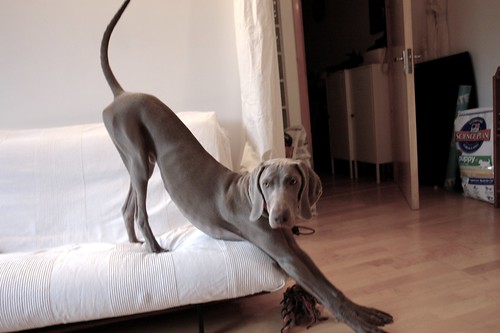


 Yoga योग (1)